
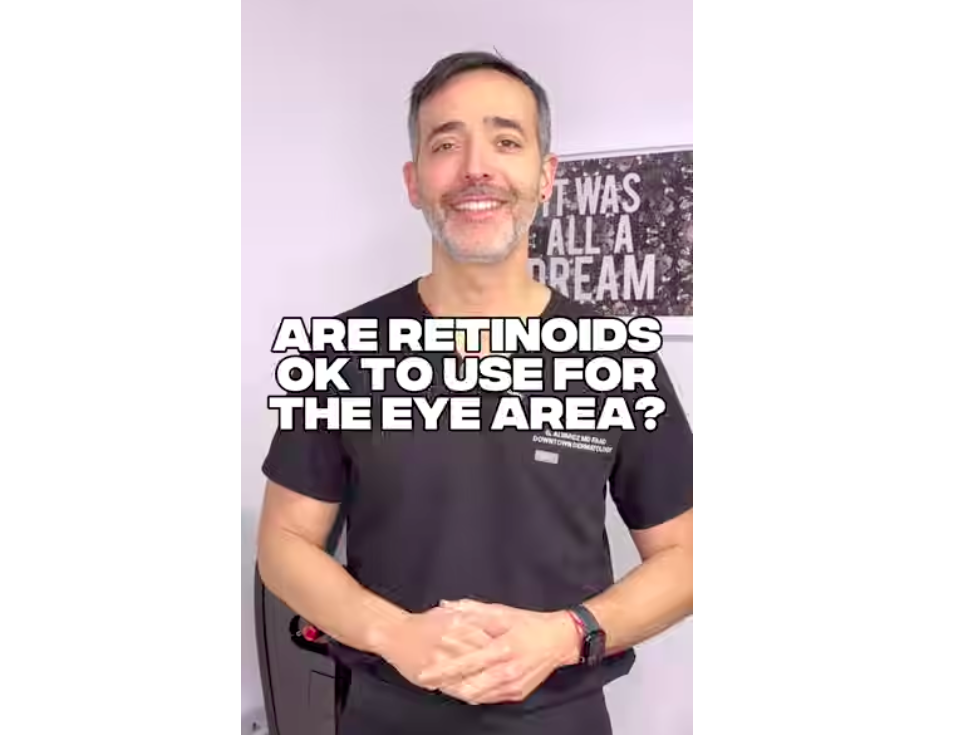
It's one of the most common skincare questions Dr. Alvarez hears, and the answer might surprise you.
Your eyelids are the thinnest skin on your entire body. Not just your face, your whole body. That means they react fast, and not in a good way.
Dr. Alvarez sees it all the time in his Tribeca office: patients come in with red, irritated, flaky skin around their eyes after using prescription-strength retinoids like tretinoin, adapalene, or tazarotene too close to the eye area. That irritation has a name, contact dermatitis, and it's one of the most common reasons people give up on retinoids altogether.
The skin around your eyes simply can't handle what the rest of your face can.
This is where things get interesting. A lot of cosmetic companies have figured this out and created retinol formulas specifically designed for the eye area, and according to Dr. Alvarez, "they are great and they're better tolerated."
These aren't the same high-strength prescription retinoids that cause all the irritation. They're gentler retinol products engineered to work on delicate skin. A few brands Dr. Alvarez mentions by name include SkinBetter and ISDIN, both of which make over-the-counter retinol products safe for use around the eyes.
Most of these products are designed for the lower eyelid, the area where fine lines, crepiness, and texture tend to show up first.
Dr. Alvarez's advice here is simple: go slow.
If you have sensitive skin, start by applying the product every other night. See how your skin responds. There's no rush. The goal is to build tolerance gradually, not shock the thinnest skin on your body into a reaction.
And for the more adventurous? Dr. Alvarez says you can potentially use these products on the upper eyelid too, but with a big caveat. Use very little product, and be extra careful. The upper eyelid tends to concentrate whatever you put on it, which means irritation can happen faster than you'd expect.
In his words: "Just go very slowly and put very little, because the upper eyelid concentrates whatever you put up there and might get irritated faster."
If you've tried an eye-area retinol and you're dealing with persistent redness, peeling, or irritation that won't calm down, it's time to come in. Dr. Alvarez can evaluate your skin, rule out contact dermatitis, and recommend the right product and routine for your specific skin type.
And if you're not sure which retinol is right for the eye area, or whether your current retinoid is too strong — that's exactly the kind of question a board-certified dermatologist can help you answer.
Ready to talk retinoids? Book an appointment with Dr. Alvarez at Downtown Dermatology NYC and get a personalized plan for your skin, eyes included.
